12 Paint Colors That Make a Small Living Room Look Bigger
Twelve decorator-loved paint colors that make a small living room feel bigger, brighter and calmer, with the undertone traps to avoid in each one.
By SmallNestDecor Editors · October 20, 2026
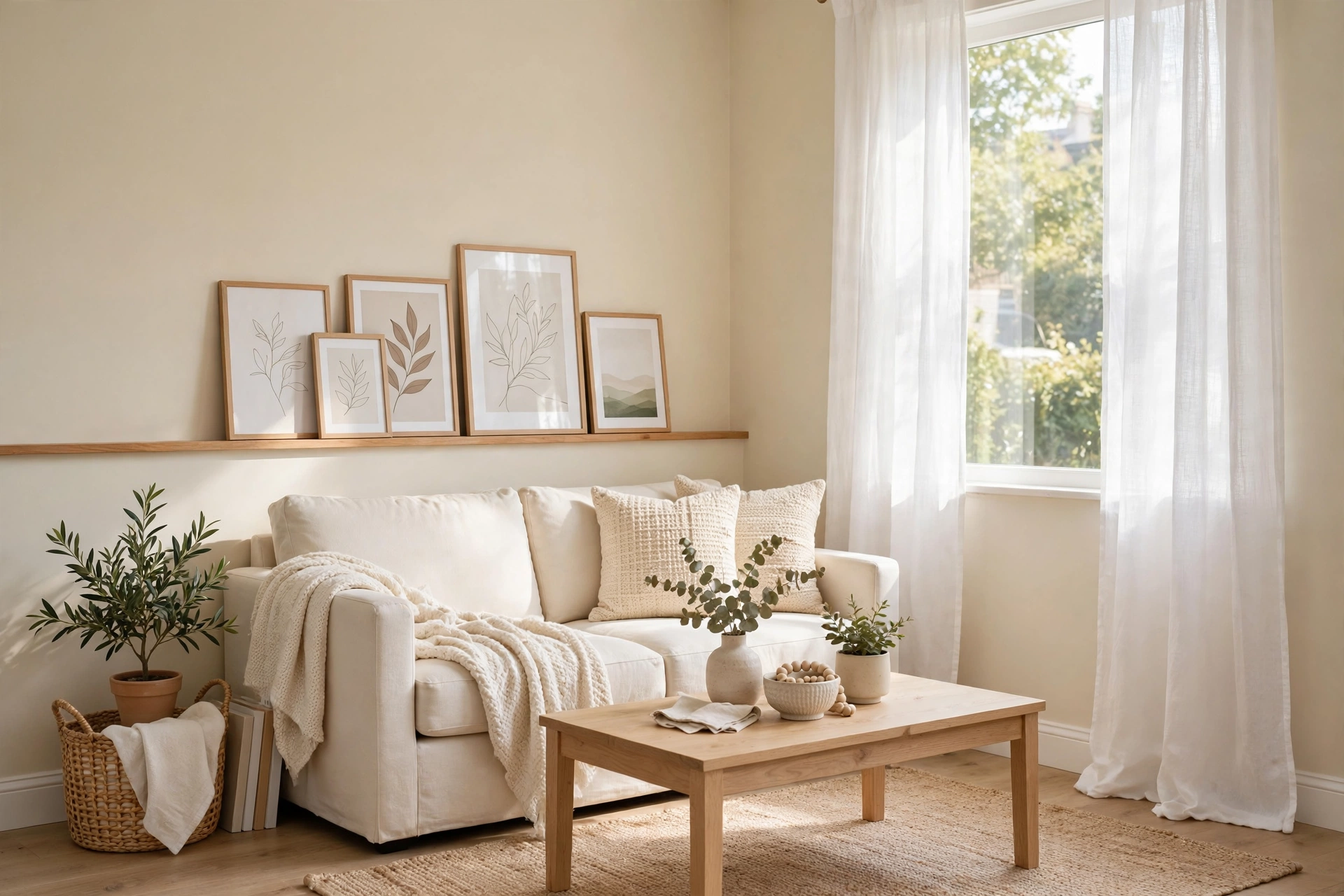
A small living room has one unfair advantage: it takes about two gallons of paint to completely change how it feels. No new sofa, no renovation, no landlord drama, just a color that makes the walls step back and the light stay a little longer. The trick is choosing a shade that works with a small footprint instead of apologizing for it.
Below are the twelve colors we reach for again and again in compact living rooms, organized from the safest warm whites to two brave, deep shades that, honestly, make some small rooms feel bigger than any white can. Every pick includes the undertone trap to watch for, because in a small room you sit close to your walls, and undertones are nowhere to hide.
The warm whites (the safest place to start)
1. Benjamin Moore White Dove (OC-17)
White Dove is the warm white we recommend when someone says “just tell me what to buy.” It has a soft greige base that keeps it from ever looking stark, and in small rooms it reads as clean, creamy light rather than paint. Watch out: in a room with very warm wood floors it can lean slightly yellow at sunset, most people love that glow, but test it if you are yellow-averse.
2. Sherwin-Williams Alabaster (SW 7008)
Alabaster is a touch creamier than White Dove and famously kind to north-facing rooms, where cool daylight turns lesser whites blue and sad. It pairs beautifully with the beige sofas and warm woods most small living rooms already own. Watch out: under cheap yellow bulbs it can look almost ivory, use daylight-balanced bulbs and it behaves.
3. Benjamin Moore Swiss Coffee (OC-45)
Swiss Coffee is the coziest of the three, a warm, slightly deep white that makes a small living room feel like a reading nook in the best way. It is a wonderful choice when your furniture is white or light gray, because it gives the room a gentle outline. Watch out: it has real depth, so in a room with one small window it may read beige rather than white. That is a feature if you want warmth, a bug if you want bright.

The greiges and soft neutrals (small-room camouflage)
4. Sherwin-Williams Agreeable Gray (SW 7029)
One of the best-selling paint colors in America, and in small living rooms it earns the title. Agreeable Gray is a true greige, warm enough for north light, balanced enough for south, and it makes a small room feel finished rather than decorated. It is also the friendliest backdrop if your sofa, rug and art are all slightly different neutrals. Watch out: it can flash a faint violet in rooms with lots of cool LED light. The swatch test will tell you in one evening.
5. Sherwin-Williams Accessible Beige (SW 7036)
Despite the name, Accessible Beige behaves like a light, warm greige with more depth than Agreeable Gray. In a small room that depth is useful: it gives white trim and light upholstery something to stand against, so the room reads layered instead of washed out. Watch out: it is noticeably deeper, in a tiny, dark room it may feel like a color choice rather than a neutral. Own it, or go one shade lighter.
6. Benjamin Moore Revere Pewter (HC-172)
Revere Pewter is the designer classic for small, traditional living rooms, a warm gray with a whisper of green that makes wood furniture look expensive. It is deeper than the others here, which is exactly why it works: the walls feel intentional, and the room’s size stops being the first thing you notice. Watch out: in low light it goes moody and a little muddy. Best in small rooms that still get one honest window of daylight.
The soft colors (for rooms that want a personality)
7. Sherwin-Williams Sea Salt (SW 6204)
Sea Salt is a chameleon, a gray-green-blue that shifts with the light and makes small living rooms feel like morning air. It is the color we suggest when white feels boring but a “color” feels risky. Watch out: it reads greener next to warm wood and bluer next to gray upholstery. Neither is wrong; just know which Sea Salt you are getting before the second coat.
8. Sherwin-Williams Evergreen Fog (SW 9130)
A soft, grayed sage that somehow makes small rooms feel calm instead of closed in, partly because our eyes read green as “outdoors” and relax the room’s edges. It is superb with cream sofas, rattan, and the plants you were going to buy anyway. Watch out: it darkens considerably in the evening; lamps with warm bulbs keep it friendly.

9. Farrow & Ball Setting Plaster (No. 231)
A dusty, grown-up pink that behaves like a neutral in small doses, which, in a small living room, is all the doses there are. It flatters skin tones, firelight, and every shade of wood, and it makes a tiny room feel deliberately designed. Watch out: it is unapologetically warm. If your sofa is cool gray, the two will argue; with warm whites and beiges, it is magic.
The brave two (deep colors that blur the walls)
10. Sherwin-Williams Iron Ore (SW 7069)
Here is the small-room secret nobody believes until they see it: paint all four walls a near-black charcoal like Iron Ore, keep the ceiling the same color, and the corners disappear. The eye cannot find the room’s edges, so the room stops announcing its size. Light furniture and one pale rug do the contrast work. Watch out: this is an all-in move. One dark accent wall in a small room just makes the wall come closer; the blur only works when every wall joins in.
11. Benjamin Moore Hale Navy (HC-154)
Hale Navy is a deep, classic navy that behaves the same way, walls recede, brass and wood glow, and a small living room turns into a library-like cocoon. It is the braver choice for north-facing rooms, where its richness reads as intentional rather than cold. Watch out: test your lighting first. Two warm lamps minimum, or the room sulks after dark.
The rental-safe wildcard
12. Your landlord’s white, warmed up without repainting
If painting is not allowed, you can still steal most of the effect: choose one of the whites above for your largest textiles instead. A White Dove-toned rug, Alabaster-cream curtains hung wall-to-wall, and warm 2700K bulbs will warm a cold rental white by a full shade, and it all leaves with you. When you do get permission, you will already know your color.
The rule underneath all twelve: in a small room, light is square footage. Pick the color that keeps the most light in the room, and test it on two walls, for one full day, before you commit.
How do you choose your final shade in one weekend?
- Shortlist three from the family that matches your light: warm whites for north-facing, greiges for mixed light, a deep color if you have one good window and a brave heart.
- Paint big swatches, at least 30 × 30 cm, on two different walls.
- Live with them for 24 hours. Morning, afternoon, lamps on. The color that never annoys you wins.
- Paint the ceiling the same color or one step lighter to lift the room.
- Use eggshell or satin finish so the walls give a little light back.
Do that, and your small living room will not just look bigger, it will stop feeling like a compromise at all.
Questions, answered
What is the single best paint color for a small living room? +
For most small living rooms, a warm white or soft greige with an LRV between 60 and 75 is the safest win, Benjamin Moore White Dove and Sherwin-Williams Agreeable Gray are the two we recommend most. They reflect enough light to open the room up without the cold, blue cast that makes north-facing rooms feel smaller.
What does LRV mean, and what range works in a small room? +
LRV is Light Reflectance Value, a 0 to 100 scale printed on most paint swatches that shows how much light a color reflects. For a small living room that needs to feel bigger, aim for 60 to 75: bright enough to bounce light around the room, with enough body to avoid the stark, clinical feel of the very highest values.
Do dark colors really make a small living room look bigger? +
Counterintuitively, yes, sometimes. A deep, saturated color on all four walls blurs the corners, so the eye stops reading exactly where the room ends. It works best in rooms with one good window and lighter furniture to contrast against. It fails in dark, windowless rooms, where it just feels like a cave.
Should the ceiling be painted the same color as the walls? +
In a small room, painting the ceiling the same color (or one shade lighter) removes the visual 'lid' and makes the walls feel taller. A bright white ceiling against mid-tone walls draws a hard line that can make a low ceiling feel even lower.
What finish should I use in a small living room? +
Eggshell or satin. They reflect a little light, which helps the room feel larger, and they wipe clean, important when furniture sits close to walls. Flat paint hides flaws but absorbs light and marks easily in tight spaces.
How do I test a paint color properly in a small room? +
Paint two large swatches (at least 30 × 30 cm) on two different walls, and live with them for a full day. Check them in morning light, afternoon light and lamplight. In small rooms the same color can read warm at noon and gray at night, and the swatch is the only honest preview you get.